Fill out the form below to get started with a FREE consultation.
If you were injured in a semi-truck or 18-wheeler crash in Oklahoma, you have two years from the date of the wreck to file a personal injury lawsuit under Okla. Stat. tit. 12 § 95. Truck claims differ from car accident claims in three ways that change how the case is built. More than one party can be liable: the driver, the trucking company, the maintenance provider, the cargo loader, or the freight broker.
Interstate carriers hauling general freight must carry at least $750,000 in liability coverage under 49 C.F.R. § 387.9, well above Oklahoma’s 25/50/25 minimum for passenger vehicles. And the records that prove fault, including electronic logging device data and driver duty status logs, only have to be retained for six months under 49 C.F.R. § 395.8. Oklahoma’s modified comparative negligence rule lets you recover as long as you were 50 percent or less at fault, and for crashes on or after September 1, 2025, pain and suffering damages are generally capped at $500,000 unless the injuries are permanent and severe or the trucking company or driver acted with gross negligence. The Law Offices of Jeff Martin sends evidence preservation letters early so truck records are not lost, and reviews new claims at no cost.
A loaded tractor-trailer can weigh 20 to 30 times as much as a passenger car, and that mismatch determines who gets hurt. In crashes between a large truck and a passenger vehicle, the large majority of people killed are occupants of the smaller vehicle. Weight also changes what a truck can physically do: at 65 miles per hour, a fully loaded tractor-trailer needs roughly 525 feet to stop, compared with about 300 feet for a car.
That gap is why errors a car driver could recover from become catastrophic when a truck is involved, and why most truck crash causes trace back to decisions made long before the wreck.
Driver fatigue. Federal hours-of-service rules under 49 C.F.R. § 395.3 cap driving at 11 hours within a 14-hour window and require a 30-minute break after 8 hours. Electronic logging device data often shows whether those limits were respected.
Inadequate training, hiring, or supervision. A carrier that puts an unqualified driver on the road can be liable directly, separate from the driver’s own negligence.
Deferred maintenance. Carriers must maintain systematic inspection and repair programs under 49 C.F.R. § 396.3, and drivers must file inspection reports under § 396.11. Brake and tire violations are among the most common findings in roadside inspections.
Speed for conditions. Stopping distance grows with both speed and load, so a speed that is legal can still be unsafe for a loaded trailer.
Improper cargo loading. Shifting or overweight loads affect braking and rollover risk, and the party who loaded the trailer may be liable even if they never drove it.
Distracted driving. Federal rules prohibit handheld phone use by commercial drivers under 49 C.F.R. § 392.82.
Road and weather conditions. Conditions do not excuse a crash. Drivers are required to reduce speed or stop when hazardous conditions warrant it under 49 C.F.R. § 392.14.
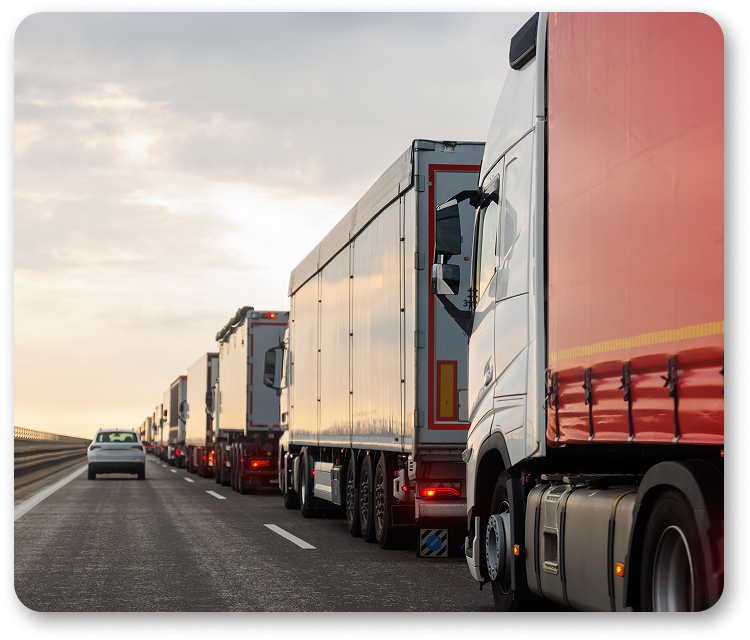
Even the most seemingly minor driving errors, such as failing to signal before passing or not accelerating sufficiently, can result in a catastrophic accident.
If you or a loved one has been involved in a truck accident in Oklahoma and need a reliable truck accident lawyer, call the Law Offices of Jeff Martin to get an experienced team on your side. As experienced truck accident attorneys, we can help you uncover the cause of your accident and fight for due compensation to cover the costs of recovery for your injuries.
We’ve established that injuries sustained in a truck accident can be very severe, if not fatal. Not only can a collision with a semi-truck or tractor-trailer cause irreparable damage to your vehicle, but it may also leave you with permanent disabilities.
Suffering from any of these can significantly alter your quality of life. Whether that be for the short-term or long-term, you need to be able to focus on your recovery and not be bogged down with legalities after an accident. If you’ve been injured in an accident anywhere in Oklahoma, the Law Office of Jeff Martin is here for you.
When you choose to work with a qualified attorney on your case and it’s determined that you have legal grounds for a claim to compensation, there are different types of compensation that you could be eligible to receive. It will all depend on the circumstances surrounding your accident and the extent of your injuries. These include:
Economic Damages – Items that can be assigned an actual dollar amount, such as medical bills, lost wages, property damage, and cost for ongoing rehabilitative services.
Non-Economic Damages – Intangible elements, such as future lost earnings, pain and suffering, or the costs of recovering from distress with grief or emotional counseling.
Punitive Damages – In rarer cases, punitive damages may be awarded if it can be proven that the at-fault driver knowingly ignored safety laws or displayed malicious, dangerous driving that resulted in the accident.
Two years from the date of the crash, under Okla. Stat. tit. 12 § 95. Missing that deadline will almost certainly end the case no matter how strong the evidence is. A separate and much shorter clock matters in truck cases: the electronic logging device and driver duty status records that often prove fault only have to be retained for six months under 49 C.F.R. § 395.8, and some carriers destroy them as soon as that period ends. A preservation letter sent early is frequently what keeps that evidence available. Claims against a city, county, or state agency follow different rules under the Governmental Tort Claims Act, requiring written notice within one year and suit within 180 days of denial under 51 O.S. §§ 156-157.
Often more than one party, which is the main structural difference between truck cases and car accident cases. The driver may be liable for negligent operation. The motor carrier may be liable both for the driver’s conduct within the scope of employment and independently for negligent hiring, training, supervision, retention, or maintenance. The company that loaded or secured the cargo may be liable for a shifting or overweight load under the securement rules in 49 C.F.R. Part 393, Subpart I, even though it never drove the truck. A manufacturer may be liable for a defective component, and a freight broker may be liable for negligent selection of an unsafe carrier. Identifying every responsible party early matters because each one carries separate insurance.
Three differences change how the case is built. Multiple parties can be liable rather than one driver. Interstate carriers hauling general freight must carry at least $750,000 in liability coverage under 49 C.F.R. § 387.9, compared with Oklahoma’s 25/50/25 minimum for passenger vehicles, so recoveries are less often capped by policy limits. And a parallel body of federal safety regulation applies to the carrier, meaning a violation of the FMCSRs can establish negligence independent of anything that happened in the seconds before impact. Carriers also typically dispatch investigators to the scene within hours, so the evidence picture starts forming before an injured person leaves the hospital.
Yes, through two separate routes. Under respondeat superior, a carrier is responsible for a driver’s negligence committed within the scope of employment. Separately, the carrier can be directly liable for its own conduct, including hiring a driver with a disqualifying record, failing to train or supervise, keeping a driver after known violations, pressuring schedules that force hours-of-service breaches, or failing to maintain the vehicle under 49 C.F.R. § 396.3. Carriers sometimes argue a driver was an independent contractor to avoid the first route, but federal leasing rules and the carrier’s operating authority often defeat that argument. The direct-liability route also survives regardless of how the driver relationship is characterized.
By establishing four elements: that the defendant owed a duty of care, that the duty was breached, that the breach caused the crash, and that you suffered actual damages as a result. Truck cases have an evidentiary advantage here, because the FMCSRs define much of the duty in writing. A driver over the 11-hour limit in 49 C.F.R. § 395.3, a carrier without a systematic maintenance program under § 396.3, or a driver using a handheld phone in violation of § 392.82 has breached a written federal standard rather than an abstract reasonableness norm. The proof comes from ELD data, driver qualification files, maintenance and inspection records, dispatch and payroll records, the engine control module download, the police report, and accident reconstruction.
The Federal Motor Carrier Safety Regulations, 49 C.F.R. Parts 350 through 399, govern interstate carriers and drivers. The parts that most often decide cases are Part 391 on driver qualification, Part 392 on driving conduct including the prohibition on driving in hazardous conditions in § 392.14, Part 393 on equipment and cargo securement, Part 395 on hours of service and ELD records, and Part 396 on inspection and maintenance. Oklahoma has adopted much of the FMCSR framework for intrastate carriers as well, so purely in-state trucking is not exempt. Commercial drivers are also subject to a lower blood alcohol threshold of 0.04 under 49 C.F.R. § 392.5.
The records the carrier controls, which is why timing matters. ELD and hours-of-service data show whether the driver was legally on the road, subject to the six-month retention floor in 49 C.F.R. § 395.8. The engine control module captures speed, braking, and throttle in the seconds before impact but can be overwritten when the truck returns to service. The driver qualification file under 49 C.F.R. Part 391 shows what the carrier knew when it hired. Maintenance and inspection records, dispatch and communication logs, bills of lading and weight tickets, drug and alcohol testing records, the police report, scene and vehicle photographs, and any dashcam or nearby surveillance footage complete the picture.